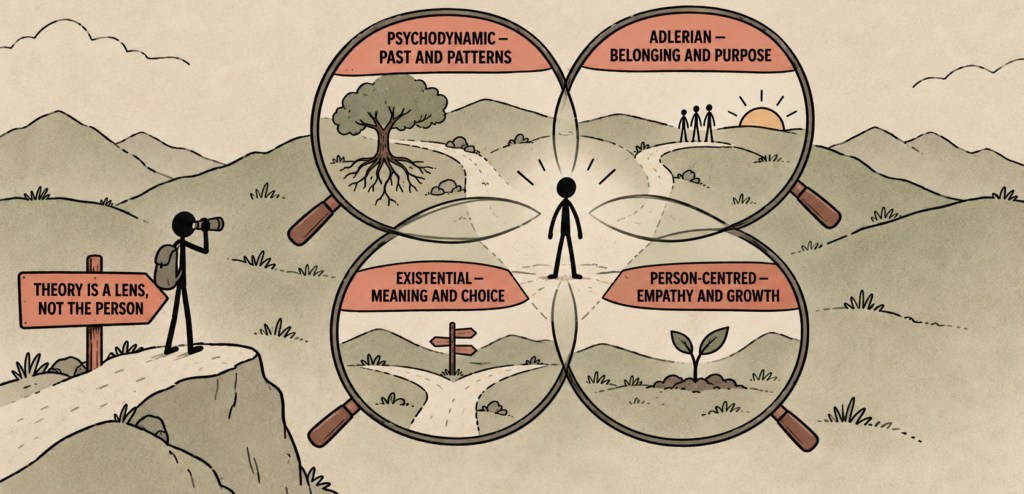
Counselling theories help us notice different aspects of a person’s experience. Each offers questions, explanations, and possible methods of helping. Responsible Christian counselling requires us to examine those contributions carefully and decide how they might serve a particular person.
As we conclude this module, our task is to compare psychodynamic, Adlerian, existential, and person-centred counselling and apply Christian discernment to their use.
Before completing the assignment below, you must finish all Module 4 lecture videos and the assigned reading. This lecture note supports your learning but does not replace those requirements.
Meeting Mekdes
Mekdes is twenty-nine. She teaches and serves in her church. When her supervisor corrects her, she feels small. Sometimes she becomes silent. At other times, she speaks sharply. Afterwards, she feels ashamed.
Her father was often away for work, and her mother valued obedience and family privacy. Mekdes wants healthier relationships, but she also fears dishonouring her family or church.
These details give us a starting point for exploration. They do not establish the cause of her difficulties. We need to hear how Mekdes understands her own experience.
Four Ways of Understanding the Case
Psychodynamic counselling
A psychodynamic approach may explore whether present correction activates an older expectation of shame, absence, or rejection. Mekdes may experience a respectful correction as a sign that someone is about to reject her.
A counsellor might ask:
“When you feel small, what do you expect the other person will do next?”
The counsellor may also notice whether Mekdes expects criticism within counselling itself. Such observations remain tentative. Mekdes must have freedom to disagree with the counsellor’s interpretation.
Adlerian counselling
An Adlerian approach may explore the purpose of Mekdes’s responses. Silence might protect her sense of belonging. Sharp speech might help her regain a sense of power. These purposes may operate without conscious planning.
A counsellor might ask:
“If this problem had less control, what would you be doing differently during correction?”
Encouragement and a small practice task could help Mekdes develop a response that supports both courage and respectful relationships.
Existential counselling
An existential approach may explore Mekdes’s values and choices within real limits. She cannot guarantee another person’s approval, but she may have choices about how she responds.
A counsellor might ask:
“You cannot guarantee approval. What would respectful courage look like in the next conversation?”
This approach can help her face uncertainty and choose a meaningful action. Responsibility must remain sensitive to circumstances and must never become blame for suffering she did not choose.
Person-centred counselling
A person-centred approach may begin by creating a relationship in which Mekdes can speak about shame, anger, faith, disagreement, and uncertainty while retaining her dignity.
The counsellor listens carefully, reflects her experience, and checks understanding. For example:
“Correction seems to leave you feeling ashamed and afraid of losing respect. Have I understood that accurately?”
The relationship gives Mekdes room to clarify her experience and correct the counsellor’s understanding.
A Framework for Christian Appraisal
Our course uses four movements to evaluate counselling theories: receive, question, correct, and use.
Receive
What truthful observation or helpful practice can we welcome?
We may receive psychodynamic attention to history and relationship, Adlerian encouragement and belonging, existential honesty about limits and meaning, and person-centred empathy and acceptance.
Question
What assumptions need examination?
We examine what each theory assumes about human nature, suffering, morality, authority, salvation, and change. A useful method does not require us to accept every assumption behind it.
Correct
How do Scripture and Christian doctrine widen or redirect the theory?
Christian appraisal considers human dignity alongside sin and self-deception, suffering alongside responsibility, and personal growth alongside grace, community, and renewal in Christ.
Use
What limited practice can we use responsibly?
We select methods collaboratively, attend to cultural meaning, and work within our competence. We should be able to explain why a particular question or practice fits the person and the stage of counselling.
Applying the Framework to Each Theory
Approach | What we may receive | What we question | Christian correction and responsible use |
Psychodynamic | Attention to history, protection, self-deception, and relationship | Reducing people to instincts or treating interpretations as certain | Understand the whole person through creation, fall, suffering, responsibility, grace, and renewal. Use tentative pattern questions. |
Adlerian | Purpose, belonging, encouragement, and contribution | Making worth depend on usefulness or treating human striving as sufficient | Ground worth in grace and encourage humble service and dependence on God. Use collaborative goals and small action tasks. |
Existential | Honesty about limits, choice, relationship, and meaning | Treating the isolated self as the source of final meaning | Locate meaning within God’s story and Christian hope. Use values questions, lament, presence, and responsible next actions. |
Person-centred | Dignity, empathy, genuineness, acceptance, and agency | Treating inner experience as final authority or overlooking sin and self-deception | Bring truth and grace together within redemption and community. Use reflections, empathy checks, and collaborative pacing. |
Culture Requires Careful Questions
Mekdes’s understanding of correction may involve family roles, church authority, gender expectations, community reputation, and earlier school experiences.
We must explore what these influences mean to her. Silence may express respect, fear, or several meanings together. Community may offer support while also making privacy difficult. Teaching about forgiveness may encourage reconciliation, but its application may also leave insufficient space to acknowledge hurt.
A counsellor should ask how Mekdes understands respect, belonging, privacy, and forgiveness before drawing conclusions about her behaviour.
Integration Requires Focus and Sequence
The four approaches can contribute to counselling, but their methods need a clear purpose and sequence.
For example, a counsellor might begin with a person-centred stance because Mekdes fears judgment. As trust develops, a tentative psychodynamic question might explore repeated expectations of rejection. An Adlerian or existential question could then help clarify a goal or meaningful next action.
This is one possible sequence. Another starting point may be appropriate if the counsellor can explain its fit with Mekdes’s needs and preferences.
The plan should remain open to revision. Mekdes’s responses, new information, and concerns about safety or competence may require a different direction.
Ethical Responsibility Remains Essential
Theory does not remove the counsellor’s ethical duties. Serious risk, abuse, severe impairment, medical concerns, or needs beyond the counsellor’s competence require assessment, consultation, and referral through the approved pathway.
Faithful Christian integration involves disciplined discernment in service of the person. It requires careful listening, theological judgment, cultural humility, and willingness to revise our understanding.