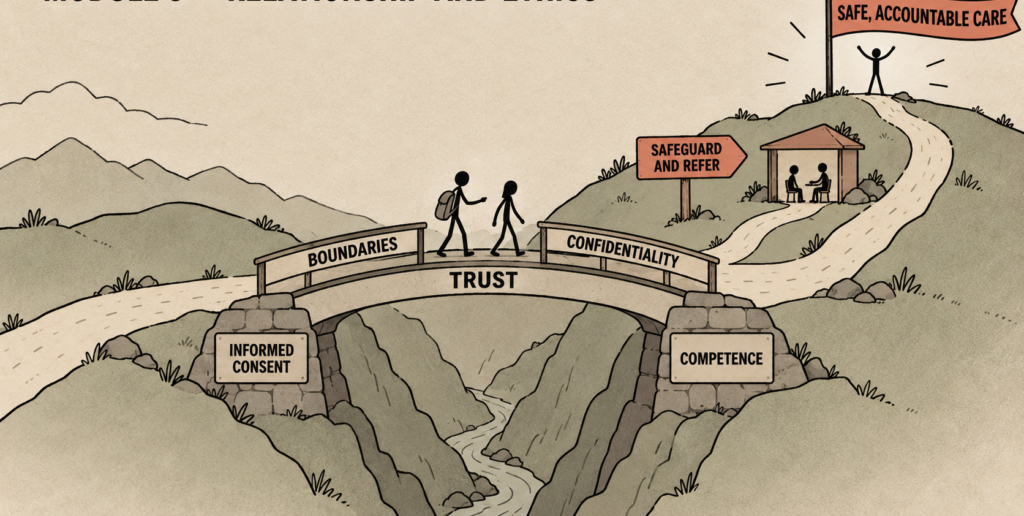
Caring well involves more than wanting to help. A person who enters counselling needs to know that they will be heard, that their choices matter, and that their personal story will be handled responsibly. They also need clear information about what the counsellor can offer and what happens when additional help is needed.
This six-part reading series explores how Christian care becomes trustworthy through a strong working relationship, informed consent, privacy, boundaries, supervision, and accountable decisions. As you read, practise explaining these ideas in ordinary words. The aim is to develop responses you could actually use in a conversation.
By the end, you should be able to explain the counselling alliance, describe an opening agreement, distinguish confidentiality from absolute secrecy, recognise risks in overlapping roles, and apply a seven-step ethical decision process.
These lessons explain ethical principles. Specific reporting duties, emergency actions, record procedures, and referral pathways depend on current Ethiopian requirements, ETC policy, and your actual helping role. Learn the approved procedures for your setting before putting them into practice.
Why caring relationships need clear agreements
When someone trusts you with a painful story, explaining limits may feel awkward. You might worry that discussing notes or availability will sound uncaring. But imagine how the person would feel if those limits appeared only later, after they had already shared something deeply personal.
Clear agreements make care more predictable. In counselling, this agreed structure is called the therapeutic frame. It explains who the counsellor is, what the work involves, where and when meetings happen, how communication works, how information is protected, and how counselling may end. It also explains supervision and the limits of the counsellor’s responsibilities.
Four terms worth understanding
A healthy boundary is a limit that serves the purpose of counselling. Agreeing on contact hours, for example, helps a counselee understand when support is available and what to do outside those hours.
A barrier blocks helpful connection. A counsellor who uses formal rules to avoid listening may maintain distance while leaving the person feeling unheard.
A boundary crossing moves outside the usual arrangement. Its meaning depends on purpose, context, culture, consent, and risk. Meeting at a shared community event may be unavoidable, but it still requires thought about privacy and expectations.
A boundary violation misuses the relationship through exploitation, deception, or harm. Sexual or romantic involvement with a current counselee is a violation. Using a person’s private story in a sermon without proper authority and permission also betrays trust.
These distinctions help us ask a better question than whether an action feels friendly: What does this action do to the counselee’s safety, freedom, privacy, and care?
Christian love includes honest limits
Neighbour love seeks the other person’s good. Truthfulness means making promises you can keep. Humility recognises the limits of your training, time, and role. The picture of different gifts and responsibilities in Romans 12:3–8 helps us recognise that one helper cannot meet every need.
Review the lesson: Distinguish a healthy boundary, a barrier, a boundary crossing, and a boundary violation.
Building a working partnership
A strong counselling relationship requires human connection and genuine collaboration. Warmth supports trust, while shared decisions about the purpose and methods of counselling protect the counselee’s participation and freedom.
The therapeutic alliance is the working partnership between counsellor and counselee. It has three connected parts: bond, goals, and tasks.
The bond is the experience of trust, respect, and being understood. Goals describe what the person hopes will change. Tasks are the activities both people agree to undertake in pursuit of those goals.
Warmth and empathy need truthful expression
Warmth communicates that a person has worth and deserves respectful attention. It does not require approval of every action. A counsellor can care about someone while discussing harmful choices honestly.
Genuineness means being truthful, acknowledging uncertainty, accepting correction, and recognising when supervision is needed. It does not require revealing every private thought or personal experience. Personal disclosure should serve the counselling purpose.
Empathy means trying to understand another person’s experience from that person’s perspective. It includes listening for feelings, meaning, relationships, culture, and faith. Understanding why someone acted in a certain way does not require agreeing with the action.
Make room for disagreement and repair
Respect for an older person, a church leader, or someone with training may make disagreement difficult. Silence or a nod may reflect uncertainty rather than agreement. Counsellors should actively invite feedback, questions, and preferences about the plan.
Sometimes the relationship becomes strained. A misunderstood comment or an unwelcome assumption may make the counselee withdraw. This is often called an alliance rupture. Repair involves noticing what happened, listening, accepting responsibility where appropriate, and agreeing on a way forward.
James 1:19 and Philippians 2:3–4 offer helpful anchors for the willingness to listen, acknowledge misunderstanding, and attend to another person’s concerns.
Review the lesson: Describe bond, goals, and tasks. Explain how collaboration strengthens each part of the therapeutic alliance.
Helping someone make an informed choice
A signature cannot tell you whether a person understands counselling or feels free to refuse it. Informed consent is an ongoing conversation in which someone receives understandable information, has an opportunity to ask questions, and can make a voluntary choice.
Consent involves understanding and decision-making capacity as well as agreement. Requirements concerning age, capacity, and other circumstances must be checked locally. A form used in another country cannot settle those questions for your setting.
Explain what the person is agreeing to
An opening conversation should cover eight areas:
1. Role and supervision: Your training, responsibilities, competence, and supervision arrangements.
2. Purpose and approach: What counselling involves and how Christian faith may be included.
3. Goals and tasks: What the person wants to work towards and how you will review progress together.
4. Practical arrangements: Location, session length, frequency, fees or free service, cancellations, breaks, and endings.
5. Between-session contact: Approved channels, appropriate uses, response times, and the approved route for urgent help.
6. Privacy and records: Confidentiality, its limits, notes, storage, and use of information in supervision.
7. Collaboration and referral: How another professional or supportive person might become involved and how permission is handled.
8. Feedback and choice: How to raise concerns, make a complaint, refuse an approach, request a change, or end counselling.
These topics can be explained in short sections and revisited. Written information supports the conversation; it does not replace it.
Check understanding without testing the person
Counsellors can check understanding by inviting the person to explain the agreement in their own words. This places responsibility on the counsellor to communicate clearly and allows misunderstandings to be addressed without blaming the counselee.
Spiritual practices also require choice. Shared Christian identity does not mean that a person has agreed to every use of prayer or Scripture. Ask permission and make refusal possible without pressure or shame.
Renew the conversation when circumstances change. Recording a session, involving family, releasing information, introducing an assessment, or changing roles may require fresh consent and documentation. Changes affecting public contact and privacy also need discussion.
Review the lesson: Explain why informed consent requires understandable information, voluntary choice, and continuing dialogue.
Protecting privacy while responding to safety concerns
A counselee’s story belongs within a relationship of trust. Confidentiality protects more than spoken words. It includes notes, messages, recordings, appointments, and even the fact that someone receives counselling.
Confidentiality has defined limits
Confidentiality is not an unlimited promise of secrecy. Safety concerns, safeguarding responsibilities, and legal requirements may affect what can remain private. The precise conditions depend on current local law, organisational policy, the person’s situation, and the counsellor’s role. General examples are not a complete list of Ethiopian reporting duties.
Five actions help organise responsible thinking:
· Explain confidentiality and its limits before deep disclosure and revisit them when needed.
· Consult appropriate supervision or designated specialist guidance, protecting identity where possible.
· Involve the counselee in decisions when safe and permitted.
· Minimize disclosure by sharing only what is needed with the appropriate person for a defined purpose.
· Document relevant facts, consultation, reasons, actions, and follow-up respectfully.
Supervision should be explained as part of the counselling arrangement. It serves responsible care and learning; it is not permission for casual storytelling.
Respond responsibly to safety concerns
Possible serious danger requires prompt clarification and a response within the counsellor’s training and approved safety pathway. Timely supervision or designated urgent support is essential. Counsellors should not promise absolute secrecy, postpone an urgent concern until a routine session, or manage high risk alone.
Safeguarding involves protecting people from harm through the responsibilities and procedures assigned to the counsellor’s role. This lesson introduces ethical responsibilities; a complete risk assessment or emergency response requires further training and approved local procedures.
Keep records that support care
Respectful notes distinguish reported information and direct observation from interpretation. They record what is relevant to care in accurate, clear language. Insulting labels, gossip, unnecessary spiritual judgments, and unrelated details weaken the quality of records and can harm the counselee.
Records need approved storage, access, retention, disposal, and continuity arrangements. Messaging also carries privacy risks through notifications, shared devices, screenshots, and backups. Familiar technology does not remove the need for careful agreements.
Review the lesson: Explain confidentiality, its limits, and the principle of minimum necessary disclosure.
Recognising power and overlapping roles
Counsellors influence how problems are understood. They hold sensitive information and may have authority through training, age, employment, or church leadership. That power creates responsibility, especially when a person fears disappointing the helper.
A dual or multiple relationship exists when counselling overlaps with another role. A counsellor may also be someone’s teacher, employer, neighbour, relative, friend, or ministry leader.
Some overlaps may be difficult to avoid in a small community. Others create serious conflicts or exploitation. Sexual or romantic involvement with a current counselee is unacceptable. Formal counselling of a close friend or close family member also compromises the objectivity and freedom the work requires.
Look beyond the existence of a second role
Assess the overlap through five actions: identify the roles, assess the risks, discuss expectations, protect the person, and review the arrangement over time.
Ask whether the overlap could impair judgment, reveal private information, create special treatment, or reduce freedom to refuse or end counselling. Consider whether supervision, changed responsibilities, clearer limits, or referral would better protect the counselee. Consent matters, but it cannot make exploitation ethical.
Consider culture through questions
Close community ties may offer belonging and practical support. They may also increase fear of gossip or shame. Respect for elders, hospitality, family responsibility, gender, and church authority can carry different meanings for different people. Ask what these relationships mean to this person rather than treating Ethiopian communities as uniform.
Gifts require similar judgment. Consider their value, purpose, timing, cultural meaning, institutional policy, and potential to create obligation. Money, personal social-media contact, and self-disclosure also need careful boundaries. Before sharing a personal experience, ask whether it serves the counselee or meets your own need for comfort or admiration.
First Peter 5:2–3 connects leadership with willing service and warns against domination. In counselling, that means taking responsibility for the effects of your influence and welcoming accountability.
Review the lesson: Explain how overlapping roles can affect privacy, freedom, judgment, and power. Why is consent alone insufficient to resolve every conflict?
Making decisions you can explain and review
Ethical problems often involve several responsibilities at once: respecting privacy, protecting welfare, preserving trust, working within competence, and responding to institutional expectations. Good intentions alone cannot determine how these responsibilities should be balanced.
A structured process supports careful reflection and prompt action when welfare requires it.
Seven steps for ethical decisions
1. Stop and name the concern. Identify the ethical issue and the emotions influencing you. Fear, loyalty, external pressure, and the desire to rescue can influence judgment.
2. Clarify the facts. Consider the counselee’s wishes, immediate circumstances, consent, culture, power, the counsellor’s competence, and what remains unknown. Separate facts from assumptions.
3. Protect immediate welfare. Follow the approved safety or safeguarding pathway promptly when required. Do not delay urgent action to complete a written exercise or investigate beyond your role.
4. Consult relevant guidance. Bring together Scripture and sound theology, current local law and policy, the ethical code relevant to the role, supervision, and specialist guidance where needed.
5. Consider reasonable options. Examine benefits, harms, privacy effects, costs, access, and cultural meaning. Possibilities may include clearer agreements, changed ministry responsibilities, additional care, or referral.
6. Choose and communicate a proportionate response. Explain the action clearly, involve the counselee where possible, and share only necessary information with appropriate people when disclosure is justified.
7. Document and review. Record facts, consultation, options, reasons, actions, and follow-up. Review the outcome and address harm or misunderstanding where needed.
These steps support judgment; they do not replace local procedures or supervision. New information may require returning to an earlier step.
Bring Christian commitments into the reasoning
Human dignity calls counsellors to respect each person’s voice and agency. Neighbour love seeks the counselee’s welfare. Truthfulness prevents false promises. Justice and protection draw attention to vulnerability and power. Wise counsel challenges the belief that a caring helper should manage everything alone.
Mark 12:29–31, Micah 6:8, Ephesians 4:15 and 25, and Proverbs 11:14 provide anchors for reflection. A biblical passage contributes to ethical reasoning alongside careful attention to role, facts, law, and policy; a verse alone is not a complete disclosure procedure.
Supervision can reveal blind spots, rescuing impulses, cultural assumptions, and competence limits. Seek it early. Referral can also express care when needs or role conflicts exceed what the counsellor can responsibly manage.
A useful referral explains the reason, offers meaningful choices, considers faith and culture, addresses access and cost, and plans continuity within the agreed role. Giving someone a name they cannot contact is insufficient support.
Review the lesson: Recall the seven ethical decision steps and explain how supervision supports responsible judgment.
Check your understanding
Try answering before reading the suggested responses.
1. Why is warmth alone insufficient for a therapeutic alliance?
2. Does signing an initial consent form complete informed consent?
3. Does a pastoral referral automatically authorise updates to the pastor?
4. Can consent make every dual relationship ethical?
5. What should a trainee do when uncertain about a serious safety or ethical concern?
Suggested responses
1. A strong alliance also requires collaboration about goals and tasks.
2. No. Consent requires understanding and voluntary choice and must be revisited as circumstances change.
3. No. Leadership or referral alone does not grant access to counselling information. Proper permission, authority, and applicable requirements must be considered.
4. No. Consent cannot remove exploitation, serious conflicts, impaired judgment, or prohibited conduct.
5. Protect immediate welfare through approved procedures, consult promptly, verify relevant requirements, and document the reasoning and response.
Continue your reading
These lessons adapt the Module 3 Complete Video Script and Module 3 Lessons and Discussion Prompts. The source materials identify the following resources for further study:
· ETC Counselling 2 materials on the therapeutic frame and therapeutic alliance.
· Siang-Yang Tan, Counseling and Psychotherapy A Christian Perspective, Baker Academic, 2011, particularly chapters 2 and 14.
· AACC Christian Counseling Code of Ethics, 2023.
· ACA Code of Ethics, 2014, especially Sections A to C.
· BACP Ethical Framework for the Counselling Professions.
· Christoph Flueckiger and colleagues, The Alliance in Adult Psychotherapy A Meta Analytic Synthesis, Psychotherapy, 2018.